
What Is an Impact Export and How Can It Help Your Career?

What Is an Impact Export?
An impact export is a portable, shareable record of the outcomes you have created at work, not just the tasks you completed. It is not a diary and it is not a to-do list. It is proof, organized in a way that a manager, client, or interviewer can quickly understand.
You use an impact export for performance reviews, promotion packets, client renewals, case studies, interviews, and salary negotiations. Unlike a timesheet or an activity report, it centers on evidence and narrative. By the end of this article, you will know exactly what to capture, how to format it, and how it can move your career forward.
Why Most Smart People Still Struggle to Show Impact
Most people do good work and still forget the details by the time a review comes around. This is recency bias, and it quietly punishes people who worked hard earlier in the year. If you want a deeper breakdown of this problem, this guide on how to fix recency bias in your performance review is worth reading.
Knowledge work is often invisible. Collaboration, incident response, mentoring, and quiet quality improvements rarely show up anywhere official. Many people fall into the to-do list trap, where finished plans get mistaken for proof of value. Then review season arrives and everyone scrambles for examples.
Impact Export vs To Do Lists, Task Managers, and Brag Documents
A to-do list tracks intent. A task manager tracks execution. An impact export captures outcomes, evidence, and context, which is a different job entirely. People sometimes compare it to a brag document, and the overlap is real.
The difference is structure. An impact export is built to be exportable and stakeholder ready, not just a private note file. Think about audience, cadence, level of detail, format, and reusability. The best system stays light enough that you can maintain it weekly without dreading it.
The Six Building Blocks of an Impact Export
A useful impact export follows a repeatable shape. Priority connects the work to what mattered that week, whether that is a business goal, an OKR, or a client objective. Action describes what you actually did.
Outcome should be quantified whenever possible, such as time saved, revenue influenced, defects reduced, or a lift in customer sentiment. Evidence includes links, screenshots, tickets, pull requests, dashboards, or testimonials. Stakeholders names who benefited. Next step outlines what will compound the win going forward.
A Table Worth Actually Reading: Proxy Metrics When You Have No Hard Numbers
Not every job produces clean numbers, and that is where proxy metrics help. This table is a reference you can return to whenever you are stuck on how to phrase an outcome for your impact export.
| Type of Work | Proxy Metric to Use | Example Phrasing |
|---|---|---|
| Mentoring a teammate | Ramp-up time reduced | Cut new hire onboarding from six weeks to four |
| Incident response | Time to resolution | Restored service within 40 minutes of the alert |
| Process cleanup | Steps removed from a workflow | Reduced approval steps from five to two |
| Client communication | Response time improvement | Cut client reply time from two days to same day |
| Cross-team unblocking | Number of teams unblocked | Unblocked three teams stuck on the same dependency |
| Documentation | Repeat questions avoided | Answered a recurring question once, in writing, for good |
Examples of an Impact Export Across Different Roles
A software engineer might log that they refactored a slow API endpoint, cutting load time by 40 percent, with a linked pull request as evidence. A product manager might note that they ran three user interviews that shifted the roadmap for the next quarter.
A marketer might record that a landing page rewrite lifted conversion by 12 percent, linking to the analytics dashboard. A customer success manager might document that they saved a renewal by resolving a billing dispute within a day. A consultant might use one of the best tools for consultants to track client impact and deliverables to keep these records client ready.
How an Impact Export Directly Helps Your Career
During performance reviews, an impact export reduces the effect of recency bias by giving you specific, dated examples. For promotions, it shows scope and ownership building over time, not just a single good quarter.
In salary negotiations, quantified outcomes and stakeholder proof give you real leverage. During a job search, exports convert easily into STAR interview stories, resume lines, and portfolio bullets. For client work, a periodic impact export makes renewals and upsells far easier to close.
The Simple Weekly Workflow Behind Every Impact Export
Set your priorities at the start of the week. Capture small wins as they happen. Export a short summary at the end of the week, tied back to those original priorities.
Each check-in should take less than a minute, focused only on what actually moved forward. A practical rhythm looks like this: priorities on Monday, quick check-ins on Tuesday and Thursday, and a summary on Friday. If you use Teams already, this guide on how to set up a daily check-in routine in Microsoft Teams pairs well with this rhythm.
How Progreps Turns Weekly Wins Into an Impact Export Automatically
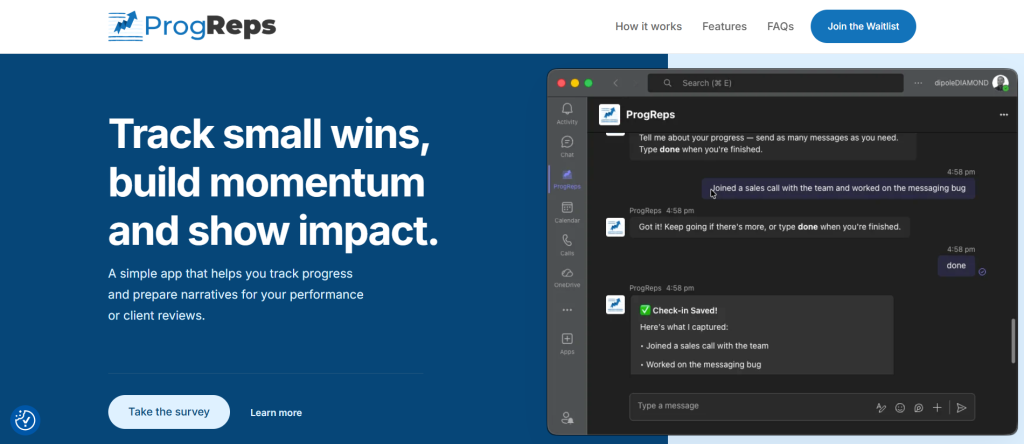
Progreps was built around this exact workflow.
- Step one is setting your priorities.
- Step two is scheduled check-ins that capture your wins as they happen.
- Step three is a periodic report that becomes your impact export.
It is not a to-do list. It captures what you actually did and shapes it into a usable career narrative. You can set the frequency and timing of check-ins, and even turn on vacation mode when you are away. If this sounds useful, you can join the waitlist for early access before it reaches wider release.
Writing Impact Statements That Do Not Sound Vague or Inflated
A simple formula helps here: did X, so that Y improved by Z, for audience A. Compare a vague line like improved team efficiency to a specific one like cut sprint planning time from three hours to one.
Acceptable proxy metrics include cycle time, response time, quality, risk reduction, and adoption rate. Avoid credit hogging, heavy jargon, and claims without evidence behind them. Before you finalize any impact export entry, check it for clarity, alignment, evidence, and relevance to your stakeholder.
What to Do If Your Work Is Hard to Measure
Not everything reduces to a clean number, and that is fine. Qualitative evidence works too, including testimonials, screenshots, decision logs, and clear before and after comparisons. Estimate time saved or risk reduced honestly, with your assumptions stated.
Document your role in collaboration, the decision you made, and the downstream effect it had. Mentoring, process improvements, incident handling, and relationship building all count. Tie each entry back to a stated priority, even without a hard metric attached.
Turning an Impact Export Into Resume Bullets, LinkedIn Updates, and Interview Stories
On a resume, convert outcomes into quantified bullets tailored to the job description. On LinkedIn, turn weekly entries into monthly updates that read as professional progress, not a highlight reel.
For interviews, reshape your impact export into STAR or CAR stories, grouped by theme such as leadership, execution, or ambiguity. For consultants and freelancers, exports become raw material for portfolio case studies. Keep a rolling list of your ten strongest wins, sourced straight from your exports.
Privacy and Professionalism in Your Impact Export
Never include confidential data such as customer records, financials, or internal strategy in a shared export. Write for the reader, keeping the language clear and avoiding internal only acronyms. Keep the tone factual and give credit to teammates where it is due.
Store your links somewhere secure and think about who has long-term access. It often helps to keep two versions on hand. One stays internal and detailed, and one is sanitized for external client use.
Common Mistakes That Make an Impact Export Useless
Logging tasks without outcomes is the most common mistake, so always add the result and the evidence behind it. Inconsistent logging is another, and scheduled check-ins fix that fast. Overly long entries bury the value, so keep the summary short and link out for depth.
Skipping the tie back to your original priorities weakens the whole narrative. And building a great impact export that never gets shared helps nobody. Send a monthly update to your manager or client, or prepare one before your next review.
A 14 Day Plan to Build Your Impact Export Habit
On days one and two, pick three priorities for the coming week. From days three through twelve, log six to eight quick check-ins, each with an outcome and a link as evidence. On days thirteen and fourteen, write a one-page weekly summary.
Identify two themes that could shape your career narrative going forward. If you want an easier route, several of the best work accomplishment tracker apps for corporate professionals can automate the reminders for you. Success looks like one clean report you would actually hand to your manager.
Frequently Asked Questions
What exactly is an impact export?
An impact export is a structured, shareable record of outcomes you produced at work. It includes the priority behind the work, the action taken, the measurable or qualitative outcome, supporting evidence, the stakeholders involved, and a next step.
How is an impact export different from a work log or a brag document?
A work log tracks activity, while a brag document is often an informal, private list. An impact export is built with a consistent structure and formatted so it can be shared directly with a manager or client without editing.
How often should I update my impact export?
Weekly works best for most professionals. A short check-in two or three times a week, followed by a Friday summary, keeps the record current without becoming a time burden.
Can I build an impact export if my job does not produce clear metrics?
Yes. Use proxy metrics such as response time, cycle time, or risk reduced, and pair them with qualitative evidence like testimonials or before and after comparisons. The goal is credible proof, not perfect numbers.
Is an impact export useful for freelancers and consultants, not just employees?
Yes, and arguably more so. Consultants can use an impact export to justify renewals, support upsells, and build case studies for future client pitches, since ongoing proof of value directly affects repeat business.
How does an impact export help during a performance review specifically?
It counters recency bias by giving you dated, specific examples from across the whole review period, not just the last few weeks. It also shifts the conversation from vague impressions to documented outcomes.
